Newsletter #4 from Spain 2025
~ by Ronte Alonso and Anna Homs
A TRUE STORY: Our Experience with Mushroom Dyes and Esparto Grass
I want to share my latest experience using mushrooms for dyeing. In this case, it involves using mushrooms to dye esparto grass fibers. I was asked to provide training for this purpose, and the results have been more than satisfactory due to their beauty and natural harmony.
Here’s a true story of how it all came about, and how it continues to develop, little by little. This work is also aimed at preserving the Popular Cultural Heritage of esparto grass culture in Spain. Passing on the knowledge of this craft to younger generations is an obligation we, the elders, have. Ronte Alonso is working in this direction, in addition to creating her own artistic pieces.
Let’s read the story as Ronte Alonso tells us:
In 2009, I met a group of women who were learning to work with esparto grass (a plant fiber that grows in southwestern Spain and North Africa). I immediately fell in love with the rugs these women made, and the ways braiding, dyeing, and sewing esparto grass could create such spectacular rugs.
That’s how I came to the home of the Blanco family, of Ubedies Artesanía, in Úbeda, Spain. Pedro Blanco is the sixth generation of esparto grass artisans. He was the one who taught me how to sew the Ubedíes rugs I admire so much. Her father, Enrique Blanco, in his book “Espartería Artística” (1982), tells us about these rugs: “This is what these rugs, known since ancient times as ‘UBEDIES’, are like, with international acclaim. Their vibrant and beautiful openwork, geometric, and arabesque designs remind us of their origins in Muslim culture. Whether their natural color or combined with red, blue, green, brown, or any other color…UBEDIES rugs were introduced by the Arabs in the 11th century…
The process for making these rugs is as follows: cooked esparto grass (soaked in water for several days) and chopped (flattened with a wooden mallet) is used to make a rope of several meters (depending on the size of the rug, tapestry, etc.) by braiding three strands, which is called soguilla. Next, we place the plan—the drawing, sketch, or pattern we want to make with the esparto rope—on a wooden board, and we begin nailing it down edge-to-edge, following the pattern with nails and a hammer. Then we can start sewing; as we sew, we remove the nails.
One of the things I liked most about the rugs was the blend of esparto grass and color, but I wanted the process to be completely sustainable. I wanted to use natural dyes made from plants, leaves, roots, mushrooms, etc. found in my environment. Master basket weaver Carlos Fontales introduced me to Anna Homs, who taught me everything I know about natural dyes, and from whom I still have much to learn. The colors I obtain from nature are special because they are the colors the earth gives us, in harmony with our surroundings. The materials (esparto grass, the dye, etc.) blend and enrich everything I create with them. The dyeing process creates a unique world of its own, in which each piece is special and one-of-a-kind.
My artistic pieces (marked by the defense of human rights and with degrowth as a goal) are realized through the techniques of Ubedíes Carpets and natural dyeing. Esparto grass dyes very well with natural dyes.
Our research going forward in this technique is based on the use of natural dyes instead of the chemical ones used in the past, choosing those that best suit esparto grass.
We have used fungi and also plants to achieve colors with sufficient intensity. We use alum and sodium carbonate mordants as a color fixative. Wood ash could also be used to complement the strength of the alum mordant.
The dyeing process is as follows:
- Chop the dry esparto grass to soften the fibers.
- Mordant with alum and sodium carbonate (three parts alum to one part sodium carbonate). Leave in the mordant for 24 hours. Let the esparto dry slowly, covered with towels, to complete the mordant process.
- Prepare the dye with enough material to obtain saturated colors. Leave the esparto in the dye until the dye is cool. Let the esparto dry without rinsing.
Good results have been obtained with Inonotus hispidus, Pisolithus tinctoreo, and the olive mushroom (Omphalotus olearius) also gave acceptable color intensity.
Inonotus hispidus is the wood mushroom that gives the best results on cellulose fibers, provided the alum mordant is reinforced with a portion of sodium carbonate. We can also use iron mordant to achieve darker tones.
Spain, July 11, 2025
For more information:
Anna Homs email: annahoms@ hotmail.com
Ronte Alonso email: espartoronte@gmail.com
Pedro Blanco email: info@ubediesartesania.com
Newsletter #3 from Spain 2019
~ by the Spanish Contingent from Gran Canaria
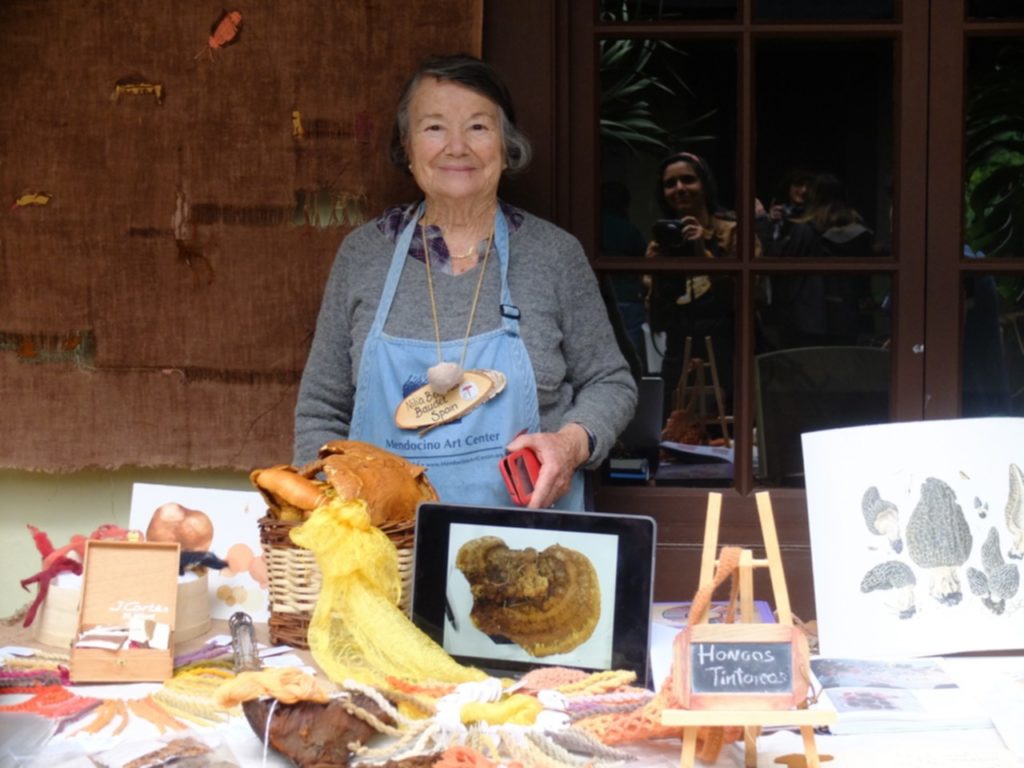
Last year’s mushroom season in Gran Canaria was especially abundant in Gymnopilus penetrans and G. spectabilis as well as the always generous Pisolitus tinctoreus. We put up a demonstration on Fungi dye during the local mycological fair held by the Sociedad Micológica de Gran Canaria where we showed off what we learned and did in Norway. We are still working on the book on Nilia Bañares’s experience dyeing with mushrooms that will hopefully be finished by next year. We would like to make a call out to any natural dyers in Spain working with fungi. Our email is tintesconhongosES@gmail.com
Newsletter #2 from Spain 2012
~ by Nilia Bañares & Maria Noelle
We are keeping busy,preparing the Symposium. We want to try to dye with vegetable linen & cotton fibes. It takes some time to prepare/mordant the fiber, but we are getting good colours, of course not so strong as with wool or silk, but it is a challenge. This year was very poor as we have not had enough rain or humidity but we hope next October will be a good one. I have participated last November with the Mycologist Society of Gran Canaria, we dedicate a week every year to the Mushrooms World, I participated with my samples of dyes from Fungi.
We are very busy organising the Symposium and we are receiving many calls so we hope for the best of it.
With best regards, Nilia
List #1 from North of Spain by Marie Noelle and Anna Homs
“not all of them give strong colours but we have used them”
Amanita caesarea – amarillo
Amanita muscaria – ( solo la cutícula) amarillo-anaranjado
Auricula Judea – amarillo-beige
Boletus erythropus – amarillo muy flojo
Calvatia gigantea – verdes claros
Cantharellus cibarius – amarillo
Clavariadelphus truncatus – lavanda ligero
Chalciporus amarellus – amarillo
Cortinarius atrovirens – amarillo
Cortinarius croceus – amarillo-anaranjado
Cortinarius malicorius – amarillo-naranja
Cortinarius sanguineus – rojo
Cortinarius rufoolivasceus – verde flojo
Fomes fomentarius – amarillos – marron
Fomitopsis pinicola – amarillo flojo
Ganoderma carnoso – verde
Ganoderma lucidum – verde muy fuertes
Gomphidus glutinosus – marron
Gymnopilus junonius – amarillo
Ganoderma carnoso – verde
Ganoderma lucidum – verde muy fuertes
Gomphidus glutinosus – marron
Gymnopilus junonius – amarillo
Hapalopilus rutilans – violeta
Hydnellum caeruleum – gris azulado
Hydnellum ferrugineum – gris verde
Hypholoma fasciculare – amarillo brillante
Hapalopilus rutilans – violeta
Hydnellum ferrugineum – gris verde
Hypholoma fasciculare – verde profundo
Laccaria amethystina – resultado nulo por tener un solo hongo
Laetiporus sulphureus – amarillo ligero
Lepista nuda – resultado nulo
Meripilus giganteus – marron
Omphalotus olearius – amarillo verdoso
Paxillus atrotomentosus – verde fuerte
Phaeolus schweinitzii – amarillo luminoso
Phellinus pomaceus – amarillos
Phellodon níger – verde gris
Pictoporus betulinus – sin interes
Pisolithus tinctorius – marron anaranjado . muy bueno
Sarcodon imbricatus – verde, gris , negro
Sarcodon squamosus – verde intenso
Strofaria aeruginosa – verde claro
Suillus bovinus – beige
Suillus variegatur – verde tierno
List #2 Canary Islands Fungi – many are the same as in Spain
LISTA DE HONGOS PROBADOS ULTIMAMENTE
Bonista nigrescens verde
Cantharellus cinereus : amarillo
Craterellus cornucopioides : amarillo ligero
Cantharellus rubescens : amarillo ligero
Calvatia fragilis ; verde claro
Fistula hepática : verde
Gyromitra esculenta : verde muy claro
Ganoderma applanatum
Gymnopilus penetrans :amarillo
Lactarius semi-sanguineus :gris verdoso
Hydnum rufescens : amarillento
Hydnum repandum : amarillo claro
Hydnellum aurantiacum ; verde fuerte
Hydnellum caeruleum
Hygrocibe cônico : amarillo verde claro
Phellinus torulosus : verde
Panerochaete sanguineo : marron rojizo
Polyporus cinabarinus : verde
Postia fragilis (Oligoporus caesius) :verde – gris
Trichaptum abetinum : beige verdoso
Volvariella bombycina : beige claro
Newsletter #1 from Spain 2011
~ by Nilia Bañares
Poster from Spain presented at the ISEND Conference in La Rochelle, France, by la Sociedad Micologica Tintórea no longer available. If anyone has a copy to share here, please contact mushroomsforcolor@gmail.com.
I was in la Rochelle, it was very well organized as many as 530 assisting and a very busy program full of interesting news and, of course, colours.
WE presented as la Sociedad Micologica Tintórea, a Poster on “ Mushrooms also for dyes”. There was not a real Presentation as there were as many as 74 different posters. But on Fungi it was only ours. I have dyed with mushrooms collected in the Islands. The Ganoderma cfresinascens grows in my garden, I have plenty of them..
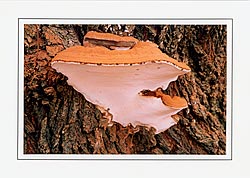
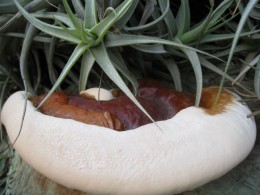
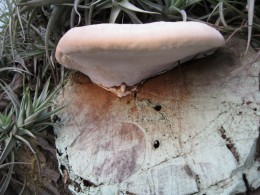
Ganoderma cfresinascens Photos © Nilia Bañares
Pisolitus tinctoreus, we get a lot by the Eucalyptus trees, Gymnopilus spectabilis and Boletus grows quite well in the woods up in the mountains. Phaeolus schweinitzii and Inonotus hispidus we get in the woods also.
I have dyed with natural vegetal fibres ,linen, cotton and it takes very well also.
In La Rochelle there were many workshops on : murex, indigo (many), saffron a beautiful job done by the Japanese.
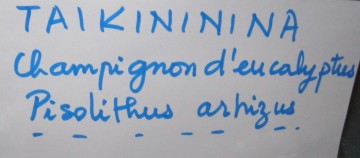
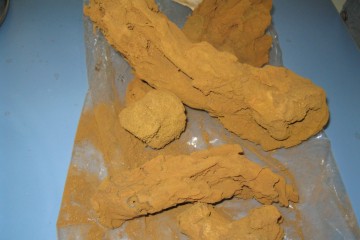
Pisolithus arhizus Photos © Nilia Bañares
There was only one man from Malaysia working with Pisolithus arhizus, a huge exemplar he says it grows by the roots of the Eucalyptus giving beautiful browns.
We are taking notes from many little big things for the Symposium in 2012. We keep your logo, as they did for Sweden and we add our logo from our card in Spain. We are working in the web-site, Anna is in charge in Barcelona and we hope we will have it ready soon.
We will keep in touch. Much love to you and all the best,
Nilia Bañares